Dorrigo Evans and Darky Gardiner’s Comradeship and Life-Saving Rescue
The Narrow Road to the Deep NorthDorrigo Evans and Darky Gardiner’s comradeship is defined by a moment of practical, life-saving action: when a shell strikes their village, Darky grabs Dorrigo and pulls him to the ground. Before that blast, they have traded banter and bets over Darky’s chances of surviving the war; afterward, the rescue remains bound to Dorrigo’s memories of the men killed beside them, Darky’s later beating, and the face Dorrigo cannot recover. Their relationship is not presented through grand declarations of loyalty, but through a wager, a quick movement, and the difficulty of making sense of what followed.
A Comrade in the Village
At first light, Dorrigo finds Darky sitting by a fire in the village’s main street, settled in an opulent armchair upholstered in blue silk and patterned with silver fish. The contrast between the chair and Darky’s dirty khaki clothes makes him seem almost incongruous in the war zone. His small kitbag, scarcely half the size of anyone else’s, yields food and cigarettes acquired by trading, foraging, or stealing. These provisions have earned him the name the Black Prince, and he tosses Dorrigo a tin of Portuguese sardines.
The morning has not yet become a direct attack. Shelling begins while the men drink coffee and wait for orders, but at first the violence seems to be happening somewhere else. Darky’s ease in this interval is characteristic of the comradeship the scene establishes: he shares what he has, talks with the others, and meets the uncertain future with jokes rather than solemnity. The violence does not interrupt a formal moment of courage; it cuts into an ordinary breakfast.
Wagers on Survival
Darky predicts that he will be dead by breakfast and offers odds on that outcome. Jack Rainbow says he would rather shoot him on the spot. Dorrigo, by contrast, stakes ten shillings at twenty to three that Darky will survive the war, and Jimmy Bigelow joins him. The bet makes Dorrigo’s confidence visible without turning it into a promise: he is willing to back Darky’s survival, though neither man can control what the war will bring.
Darky answers with a reflection on chance. Even after the same result has occurred several times, he says, the next throw remains statistically as likely to repeat it; each throw is still a first throw. The thought is both a piece of reasoning and a way of living alongside danger. Dorrigo’s wager and Darky’s account of probability give their banter an edge: they can speak as if survival were a matter for betting, while the shelling makes clear that the stakes are bodies and lives. After the explosion, Darky says he prefers to keep his bets close.
The Rescue and Its Cost
The attack becomes immediate as Dorrigo stands beside Darky’s chair, pouring coffee, and Yabby Burrows arrives with their breakfast. Hearing a shell coming in, Darky leaps up, seizes Dorrigo by the arm, and drags him down. The blast passes through them. When Dorrigo looks up, the blue armchair and its silver fish have disappeared. Darky is still holding him: the wager has given way to an act that has helped keep Dorrigo alive.
The same attack takes lives. After the first blast, an Arab boy stands amid the dust; the men call to him to get down, and Yabby runs toward him when he does not respond. A second shell kills the boy before anyone can reach him. Yabby is also killed, while Rabbit Hendricks pushes his dusty dentures back into his mouth. Dorrigo’s survival beside Darky is therefore inseparable from the losses around them. The rescue cannot make the attack meaningful or undo its other consequences; it marks one life saved amid deaths that arrive almost at random.
The Beating and the Limits of Memory
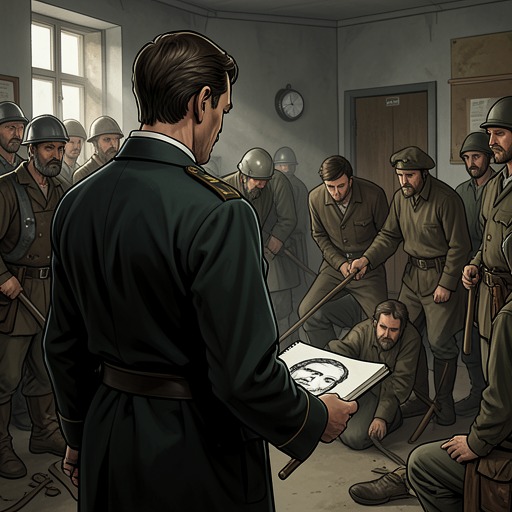
Years later, Dorrigo tries to write an account of Darky’s beating. He recalls the day as the day the men cremated a fellow prisoner whose sketchbook he had kept, and admits that his first version made the beating sound both terrible and noble. He rejects both descriptions. What he remembers instead is its misery and stupidity, and the possibility that the men carrying it out had become bored. In his account, the violence could lapse into dull, repetitive work: one man paused to wipe sweat from his forehead, then returned to beating Darky.
Dorrigo’s recollection is uncertain in its particulars. He cannot settle whether there were two or three Japanese engineers; he remembers Nakamura and the Goanna among them, but doubts his own reliability as a witness. That uncertainty does not lessen what happened. Rather, it shows the strain between the brute physical fact of the beating and the demand to make it legible afterward. Dorrigo cannot find a meaning in the violence either at the time or in retrospect, and recognizes how difficult that absence is to write down.
The Face That Will Not Return
The effort to write brings Darky back into Dorrigo’s thoughts after years in which he had not consciously remembered him. Asked what he had been talking about, Dorrigo names Darky and says that he cannot remember his face. The admission gives the relationship a painful afterlife: the man who once pulled him bodily out of danger is present in memory as a name, a rescue, a beating, and a gap where his features should be.
Dorrigo wants to recover Darky’s face, his singing, and his sly, split smile. Instead, when he tries to summon him, he sees the dirty sky over the Speedo, the forced labour where men died without reason. Darky’s observation about chance returns to him as he works on a foreword to a book of wartime sketches, but its neatness cannot explain the horror Dorrigo remembers. The comradeship persists less as a consoling story of courage than as an unresolved obligation to remember a particular man—and as Dorrigo’s recognition that he cannot fully do so.